Why AI is now a strategic priority for enterprises
The question is no longer whether a company will use AI, but where and how. Targeted investment now can shorten cycle times, improve service quality, and yield measurable advantages over competitors—across departments.
At the same time, regulation is tightening: the EU AI Act, sector rules, and expectations from customers, partners, and teams all call for clarity. One-off tool trials are not enough; you need a framework.
Below: use cases from support through to production, risks without scaremongering, and a roadmap you can actually execute in large organisations.
Strategic framework: where AI has the greatest leverage
AI delivers the strongest impact where three conditions converge: high task volume, rule-based decision logic, and available data. The strategic entry point is a process assessment, not a tool selection.
- Identify processes with the highest manual effort
- Prioritise tasks that directly affect revenue, cost, quality, or compliance
- Assess readiness: is data structured, are processes documented, are owners clear?
- Launch a pilot with defined KPIs and use results to inform the scaling decision
Autonomous digital worker at the desktop
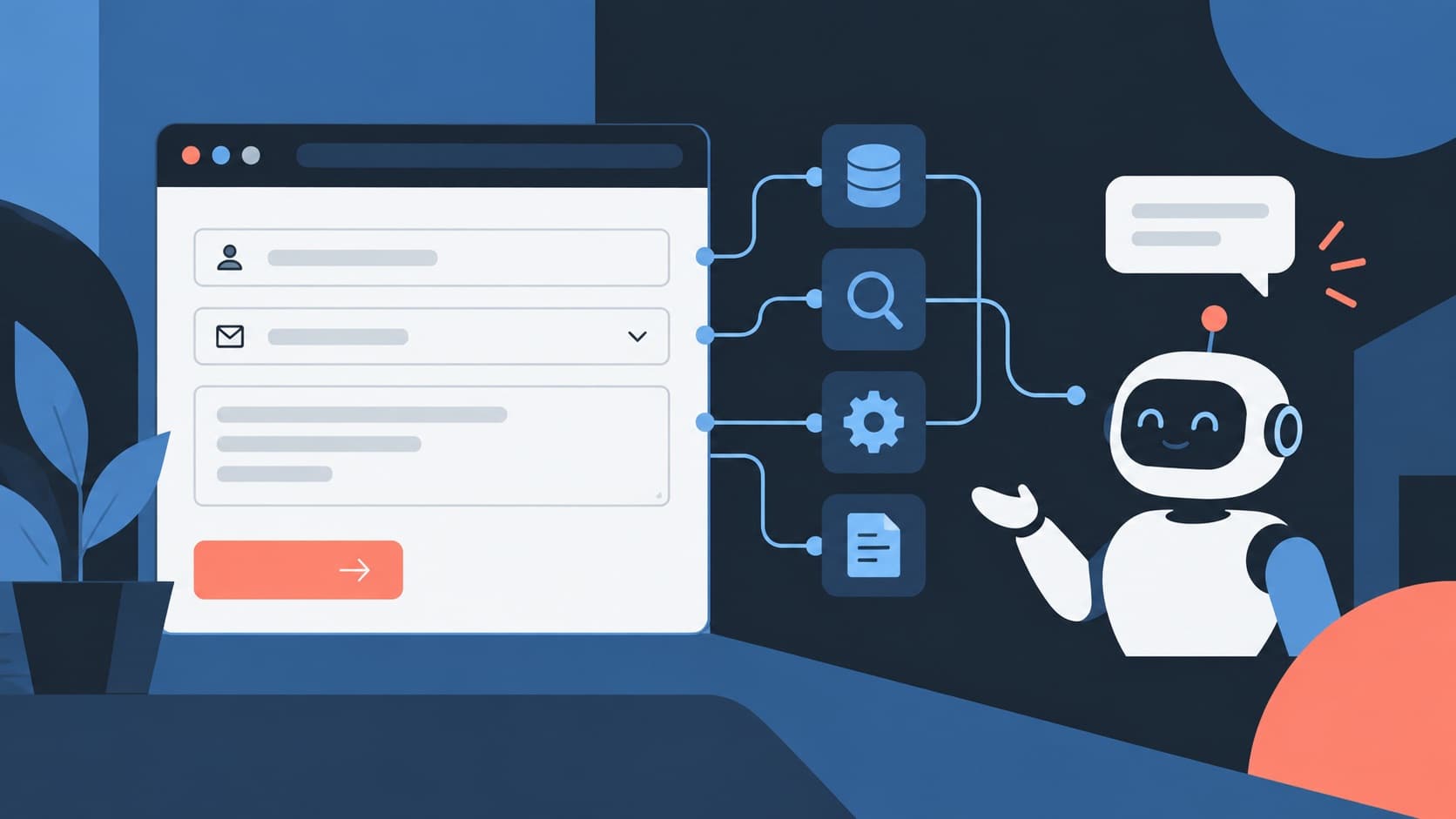
An AI agent acting as a digital worker operates inside existing enterprise tools: analysing and routing emails, summarising documents, creating records, pre-qualifying proposals, drafting minutes, and triggering follow-up actions.
Above all, less context switching and manual routine: staff still make the calls, but often gain several hours of productive time per day.
Example tasks
- Analyse inbound enquiries, classify them, and route to the responsible department
- Transcribe meetings, extract action items, and create tasks in the project management tool
- Sync CRM data from forms, emails, notes, and call summaries
- Compile daily and weekly reports from multiple data sources automatically
Measurable results
- 30–50% shorter cycle times in back-office processes
- Significantly fewer transfer errors in repetitive data entry
- More focus time for strategic, creative, and customer-facing work
AI phone assistants: availability and lead qualification
An AI phone assistant answers calls around the clock, conducts rule-based conversation flows, captures structured data, and hands qualified information to the right team. For organisations with high call volume, this reduces caller wait times and significantly relieves first-level support.
In an enterprise context, the phone assistant integrates with the PBX/SIP infrastructure, CRM, and ticketing system so information automatically lands in the right system.
- 24/7 call answering, including public holidays and out-of-hours
- Structured qualification (budget, decision timeline, topic, urgency)
- Automatic appointment scheduling and calendar integration
- Answering standard enquiries: opening hours, service overview, order status
- Prioritisation and intelligent routing to specialist teams
Customer support and service centres
In customer service, AI can speed up the flow: triage, draft replies, follow-up. The point is rarely to replace the team—more often to answer faster, more consistently, and in a way that is easier to audit.
In practice, a tiered model often works: AI handles standard cases (Tier 0), assists on medium-complexity issues (Tier 1), and on escalation supplies a summary of the thread so far.
Automation in support
- Automatic ticket classification by topic, product, priority, and sentiment
- Draft replies with light customisation instead of rigid templates
- Summaries of long ticket or chat histories for faster handovers
- Proactive notifications for known incidents or open follow-ups
- Multi-language support via real-time AI translation
Quality standards
- Clear escalation criteria: when must a human take over?
- Customer transparency when AI is responding
- Regular quality audits with spot checks and CSAT tracking
Sales and business development
In sales, AI accelerates the full cycle from lead generation to close. The biggest levers are prioritisation, personalised outreach, and reducing administrative overhead that keeps reps away from active customer work.
- Lead scoring and prioritisation: automatic ranking by purchase likelihood using CRM data, behaviour signals, and firmographics
- Personalised outreach drafts: AI creates first versions of emails, proposals, and follow-ups—sales reviews and refines
- Pipeline analysis and forecasting: early detection of deal risk, stagnation, and upsell potential
- Competitive intelligence: summaries of publicly available competitor activity, market moves, and tenders
- Conversation analytics: analysis of sales calls (consent required) to identify winning patterns and coaching opportunities
- Quote configuration: support in assembling complex proposals from product catalogues and pricing logic
Marketing and corporate communications
Marketing uses AI for drafts, campaigns, and analysis. Speed alone is not enough—brand voice and sign-off stay with people.
The channels themselves are shifting too: since August 2026 ads run inside ChatGPT. What that means for targeting, ad copy and landing pages is covered in ChatGPT ads launch in Germany and Austria.
- Content creation and optimisation: first drafts for blog posts, social media, newsletters, and landing pages based on briefs and audience analysis
- SEO and AI search optimisation: keyword clusters, content-gap analysis, and optimisation suggestions for classic and AI-powered search engines
- Campaign management: A/B test variants for ads, automated budget reallocation, and performance reporting
- Market research and sentiment analysis: evaluation of customer feedback, social mentions, and review sites
- Personalisation at scale: dynamic content in email campaigns and on websites based on user profiles and behavioural data
- Corporate communications: drafts for press releases, internal updates, and crisis responses—final sign-off by communications leads
HR, recruiting, and people development
In HR, AI cuts routine and can ease day-to-day support. Recruiting and learning offer quick wins—but fairness and explainability matter especially here.
- Applicant screening: shortlisting against objective criteria (bias audit and documentation mandatory under the EU AI Act—high-risk use case)
- Job postings: optimising wording for reach, inclusion, and target-audience alignment
- Onboarding: personalised induction plans, automatic document provisioning, and FAQ bots for new starters
- Learning and development: individualised course recommendations, auto-summaries of training content, skills-gap analysis
- People analytics: early-warning indicators for attrition, engagement analysis, and workforce planning from historical data
- Employee self-service: AI chatbot for leave, benefits, payroll, and policy questions
Finance, controlling, and procurement
Finance teams process large data volumes with high accuracy requirements. AI delivers significant value in data preparation, anomaly detection, and report generation—provided results are validated by qualified staff.
- Invoice processing: automatic capture, assignment, and plausibility checking of incoming documents
- Report automation: monthly, quarterly, and ad-hoc reports compiled and formatted from multiple data sources
- Anomaly and fraud detection: pattern recognition in transaction data to flag duplicates, outliers, or compliance breaches
- Cash-flow forecasting: predictions based on historical payment flows, open items, and seasonal patterns
- Procurement: supplier evaluation, price benchmarking, contract analysis, and automated order suggestions
- Audit preparation: compilation and pre-review of supporting documents for internal and external audits
IT, software engineering, and cybersecurity
IT departments can use AI both to boost their own productivity and to safeguard enterprise infrastructure. The spectrum ranges from development support to threat detection.
- Code assistance: review suggestions, test generation, refactoring recommendations, and documentation—human approval before any production deployment
- IT service management: automatic ticket triage, knowledge-base solution suggestions, and escalation routing
- Incident management: incident summaries, root-cause suggestions, and auto-drafted post-mortems
- Cybersecurity and SOC support: anomaly detection in network traffic and logs, alert triage, false-positive reduction
- Infrastructure monitoring: predictive maintenance for servers, storage, and network components based on telemetry
- Documentation: automatic updates to runbooks, API docs, and architecture descriptions
Operations, logistics, and quality management
In manufacturing and logistics, AI augments traditional control systems with data-driven decision support. Results flow in as recommendations and are validated by process owners.
- Visual quality inspection: image and sensor analysis for initial assessment of surfaces, labels, packaging, and dimensional accuracy
- Predictive maintenance: maintenance-need forecasting from machine data, vibration, and temperature sensors
- Demand and inventory forecasting: planning based on historical data, seasonality, and external factors (weather, market data)
- Route and tour optimisation: efficiency gains in logistics and field service through dynamic routing
- Supply-chain visibility: risk detection for supplier disruptions, transport delays, and availability bottlenecks
- Process documentation: automatic capture and structuring of production logs and batch records
Legal, compliance, and data protection
In legal departments, AI dramatically accelerates document analysis and research. Decisions and advice remain exclusively with qualified legal professionals—AI provides preparatory work and structure.
- Contract review and CLM: first-pass review of contracts for standard clauses, deviations, and risk flags
- Regulatory monitoring: automatic alerts for relevant legislative changes and compliance requirements
- Due-diligence support: structured analysis of large document sets for M&A, partnerships, or vendor assessments
- GDPR and privacy compliance: preparation of checklists, processing records, and data-protection impact assessments
- Whistleblowing systems: classification and anonymisation of incoming reports
- Internal policies: drafts for policies, training materials, and compliance FAQ systems
Facility management, real estate, and ESG
Even where digital maturity is lower, AI can still help—for example with building controls or ESG reporting—provided the underlying data is sound.
- Smart building controls: optimise HVAC, lighting, and energy use based on occupancy data and weather forecasts
- Maintenance management: predictive maintenance for lifts, HVAC, and building services
- Space management: occupancy analysis and recommendations from sensor data and booking systems
- ESG reporting: automated data collection and report generation for sustainability KPIs (carbon footprint, energy use, supply-chain ratings)
- Property valuation: market analyses and valuation drafts from publicly available comparable data
Research, development, and innovation
In R&D, AI accelerates knowledge processing and hypothesis formation. Creative and scientific evaluation remain with the specialist team.
- Literature and patent search: automatic retrieval and summarisation of publications, patent databases, and competitor disclosures
- Product development: design suggestions, material optimisation, and simulation parameters from historical project data
- Market and technology trends: analysis of public data sources to identify innovation fields and technology trajectories
- Knowledge management: aggregation and cross-linking of internal research findings across departments
Project and portfolio management
Project managers and PMOs benefit from AI in planning, risk management, and communication—especially in organisations running many initiatives in parallel.
- Resource and capacity planning: staffing recommendations based on availability, skill profiles, and historical project data
- Risk early warning: automatic detection of delay patterns, scope creep, and budget variances
- Status reporting: progress summaries from Jira, Asana, MS Project, or similar tools
- Stakeholder communication: drafts for status reports, decision papers, and steering-committee presentations
Deployment methods and technical approaches
Alongside individual use cases, there are methods that work across departments—such as RAG or connected agents. What fits depends on data maturity, your systems landscape, and organisational readiness.
Retrieval-augmented generation (RAG)
- Generate answers exclusively from indexed internal documents—with citations
- Cuts hallucinations but requires curated, approved document repositories
Workflow orchestration and system integration
- AI agents trigger actions in CRM, ERP, ticketing, or HR systems by defined rules
- Multi-step processes with mandatory human approval at critical junctures (payments, contracts, personnel decisions)
Copilot features in office software
- Structure text, generate tables from freeform notes, slides from bullets—always verify facts and tone
Translation and localisation
- AI first drafts for multilingual communications; final sign-off by native speakers or professional editors
Meeting intelligence and knowledge management
- Automatic minutes, action lists, and follow-ups from meetings
- Recording only with documented consent and clear retention policies
Data analytics and business intelligence
- Natural-language queries on enterprise data (text-to-SQL, dashboard summaries)
- Pattern, trend, and anomaly detection in large datasets
Chatbots and conversational interfaces
- Internal self-service bots for IT helpdesk, HR queries, and facilities requests
- External chatbots for initial advice, lead capture, and FAQ
OpenClaw and open agent frameworks
OpenClaw (also "Open Claw") is an open-source framework for AI agents; it runs locally or on your own infrastructure and connects to existing systems via API, script, or messaging.
Open source pays off when data sovereignty and less dependence on a single cloud vendor matter—for that, operations, patching, and hardening sit with you (or your partner), not with the SaaS vendor.
The official repository is public: OpenClaw on GitHub.
Advantages
- Full control over data flows and hosting (on-premises or private cloud)
- Inspectable source code and ability to customise
- Reduced vendor lock-in for model and platform choices
Risks and requirements
- Misconfiguration can lead to security gaps or data loss
- Regular patching and vulnerability management are the operator's responsibility
- Permissions must be strictly least-privilege
- Liability for damage or data breaches rests entirely with the operator
Enterprise deployment recommendations
- Pilot in an isolated environment with defined use cases
- Logging and audit trail for all AI-triggered actions
- Approval workflows for externally visible actions (emails, bookings, database changes)
- Dedicated ops team or qualified managed-service partner for maintenance and hardening
Concerns and risks: an honest assessment
AI can prepare decisions; in sensitive areas it should rarely decide alone. The list below is not an anti-AI list—it flags what you need to watch so deployment does not go off the rails.
- Accuracy and hallucinations: language models can output incorrect or fabricated facts. Critical claims need sources, validation, or human-in-the-loop approval.
- Privacy and confidentiality: personal, business, and trade-secret data must not enter unencapsulated consumer chatbots. Processing agreements, EU hosting, and access controls are mandatory.
- Dependency and cost: API pricing, token consumption, and vendor lock-in can escalate quickly. Multi-provider strategies and clear cost models are advisable.
- Bias and fairness: training data can amplify existing prejudices—particularly critical in hiring, customer scoring, and credit decisions. Regular bias audits are necessary.
- Transparency and trust: customers and staff should be able to tell when AI is involved. Complaint mechanisms and escalation paths must be clearly communicated.
- Shadow IT: employees using private AI tools with company data is a common and underestimated risk. Clear policies, approved tools, and training are the countermeasure.
- Reputational risk: incorrect AI outputs in customer communications or public-facing content can damage brand perception. Approval processes for external content are essential.
- Organisational change: AI changes roles and processes. Without change management and employee engagement, adoption problems can derail the entire rollout.
EU AI Act and the regulatory landscape
The EU AI Act (Regulation (EU) 2024/1689) sets binding rules for AI in the EU. For companies, that means risk classes and obligations belong in the plan from the outset—not as an afterthought.
Risk tiers in the EU AI Act
- Unacceptable risk (banned): social scoring, manipulative systems, real-time remote biometric identification in public spaces (with law-enforcement exceptions)
- High risk: AI in hiring (recruiting, performance assessment), credit scoring, critical infrastructure, education—strict obligations on transparency, documentation, human oversight, and risk management
- Limited risk: chatbots and generative AI—disclosure requirements (users must know they are interacting with AI)
- Minimal risk: spam filters, autocorrect, basic recommendation engines—largely unregulated
Recommended actions
- Classify every AI use case by risk tier
- For high-risk applications: plan conformity assessments, technical documentation, and audit trails
- Implement transparency and labelling requirements in UI and communications
- Involve legal and data-protection teams early in architecture and design decisions
AI governance and organisational anchoring
AI only scales with clear ownership, policies, and quality checks. Without that, every rollout is a gamble.
Governance checklist for the AI rollout
- Purpose and scope: for each AI project—which measurable problem does it solve? Which data is processed?
- AI policy: binding usage policy for all employees—which tools are approved, what is prohibited, how does approval work?
- Roles and accountability: who approves AI outputs? Who owns incidents? Who is responsible for data quality?
- Human-in-the-loop: mandatory human approval for payments, contracts, terminations, personnel decisions, and external communications
- Data protection: processing records, processor agreements, EU hosting, data minimisation, and access controls
- Security: least-privilege principle, no secrets in prompts, regular penetration tests, and vulnerability management
- Training: ongoing sessions for all users—capabilities, limitations, risks, and correct usage
- Monitoring and KPIs: continuous tracking of quality, cost, adoption rate, and satisfaction
- Centre of Excellence (optional): central team that develops best practices, advises projects, and maintains standards
The more regulated your sector (healthcare, financial services, public sector, critical infrastructure), the earlier legal, privacy, and compliance teams should be involved.
Change management: engaging your people
AI rarely fails on the technology—more often on team scepticism, unclear communication, or fear for jobs. Change management is not optional here; without buy-in, the rollout goes nowhere.
- Communicate early: what is changing, why, and what does it mean concretely for each role?
- Make benefits tangible: demonstrate time savings, workload relief, and quality improvements using real examples from the pilot
- Identify champions: enlist engaged colleagues as multipliers and first points of contact
- Build feedback loops: regular retrospectives, open Q&A sessions, and anonymous feedback channels
- Take training seriously: plan it as an ongoing programme, not a one-off event
- Acknowledge concerns: do not dismiss anxiety—respond transparently with facts and clear perspectives
ROI and success measurement
Without numbers, AI stays a gut feeling. Baseline, pilot, comparison—that is how you justify investment and scale later.
Direct KPIs
- Handling time per case (before vs. after)
- Error and rework rate
- First-contact resolution rate in support
- Cost per case or transaction
- Lead-to-meeting or lead-to-close rate
Indirect KPIs
- Employee satisfaction and perceived workload relief
- Customer satisfaction (CSAT, NPS) in AI-supported vs. manual processes
- Time-to-market for projects using AI assistance
- Reduction in shadow IT through approved AI tools
Methodology
- Establish a baseline before the pilot
- Run A/B comparison (with AI vs. without) over at least 6 weeks
- Account for total cost of ownership: licences, API costs, training, operations, governance
Enterprise rollout roadmap
Structured roadmap for the AI rollout
Phase 1 (weeks 1–4): strategy and focus
- Analyse the process landscape and identify 2–3 pilot candidates
- Engage stakeholders: IT, data protection, business unit, works council (where applicable)
- Define target KPIs: time, quality, cost, compliance
- Evaluate vendor and technology options (cloud, hybrid, open source)
Phase 2 (weeks 5–10): pilot
- Test one clearly scoped use case in production
- Set up human-in-the-loop approvals for all critical steps
- Run weekly retrospectives with the pilot team
- Develop documentation, training, and the usage policy in parallel
Phase 3 (weeks 11–16): evaluation and scaling
- KPI evaluation: baseline vs. pilot period with documented methodology
- Capture lessons learned and finalise the governance framework
- Prioritise next use cases and plan resources for rollout
- Optional: establish a Centre of Excellence or AI competence centre
Sort processes and governance first, then roll out. That keeps effort and risk more predictable.
The most common mistakes in AI adoption
- Launching too many use cases simultaneously instead of running one pilot properly
- Focusing only on tool selection while ignoring process readiness, data quality, and governance
- No clear ownership: nobody is explicitly responsible for quality, approvals, and incidents
- No baseline and no KPIs—so success cannot be demonstrated credibly
- Not engaging employees: change management treated as optional rather than mandatory
- Involving data protection and compliance only after go-live
- Underestimating costs: API fees, token consumption, training, and maintenance not budgeted
- Trusting AI outputs blindly without validation and spot checks
IVIS MEDIA: Holistic AI solutions aligned with this guide
If you connect the use cases above with governance, risks, the EU AI Act, and OpenClaw, it becomes clear: enterprise AI hangs together—strategy, architecture, and delivery should not sit in separate silos. IVIS MEDIA supports that line: from scoping through to integration into processes and digital touchpoints.
Related services: AI consulting for use cases, tooling, and visibility in AI answers (answer engine optimisation); AI automation for processes, integrations, and automation.
Conclusion: AI adoption starts with business value, not hype
A sensible start means the business problem first, then the technology. The scope runs from digital workers and AI phone assistants through support, sales, marketing, and HR to operations, legal, facilities, and R&D.
RAG, workflow orchestration, and open frameworks such as OpenClaw extend the toolkit—but only work with governance, data protection, and clear operations.
EU AI Act: compliance is not optional. Change management decides whether teams come along. KPIs decide whether the pilot turns into more than a demo.
A structured start does not mean "everything at once"—it means measurable steps you can actually expand later.