Why accessibility for bots and AI matters more and more
More and more users no longer get answers directly from Google, but from ChatGPT, Perplexity, Google AI Overviews, or Microsoft Copilot. These systems crawl the web, read your content, and deliver summarised answers—often without sending the user to the original page.
If your website is hard for AI systems to access, it may be skipped, misinterpreted, or ignored altogether.
Accessibility for bots and AI means structuring your content so machines can read and understand it reliably. That includes semantic HTML, structured data, and clear copy—similar to users with disabilities: consistent, predictable orientation.
Those who invest early in this “bot accessibility” improve visibility in AI answers and prepare for standards such as WebMCP or llms.txt.
Why AI accesses your website
AI search engines use the open web as a knowledge source. They crawl, read, and process your content to deliver direct answers. For your site to be used as a trustworthy source, it needs clear structure, machine-readable markup, and accessible content—just like classic SEO.
With GEO (Generative Engine Optimization), good preparation becomes a strategic factor. A well-structured site wins twice: in classic search results and in AI-generated answers.
Structured data with Schema.org
Schema.org JSON-LD helps search engines and AI systems understand your content. Types such as Article, Organization, LocalBusiness, or FAQPage describe your site in machine-readable form. LLMs use this data to make precise statements and treat your domain as authoritative.
Our team supports implementation—from the SEO agency to technical delivery as part of your web development project.
llms.txt: a content map for AI systems
llms.txt is a proposal by Jeremy Howard (2024) that gives AI systems a structured overview of your website—similar to robots.txt, but with the opposite goal: while robots.txt tells bots what not to crawl, llms.txt tells LLMs which content is relevant.
The file lives at the root of your domain as /llms.txt and contains structured Markdown: core information, important subpages, and citation hints. You can see an example at ivis.media/llms.txt.
Benefits: studies suggest AI systems save around 20–30% tokens compared to raw HTML—navigation, scripts, and ads drop away. You also reduce hallucinations: clearly described content is quoted more accurately. llms.txt fits an AEO (Answer Engine Optimization) strategy and pairs well with Schema.org.
Structure: Markdown with sections such as “Key pages” or “Glossary”. Each entry: title as a link, plus a short description.
# My company

> One–two sentence summary.

## Key pages

- [Home](https://example.com/): Overview
- [Services](https://example.com/services): What we offer
- [Contact](https://example.com/contact): How to reach us
WebMCP: websites as an interface for AI agents
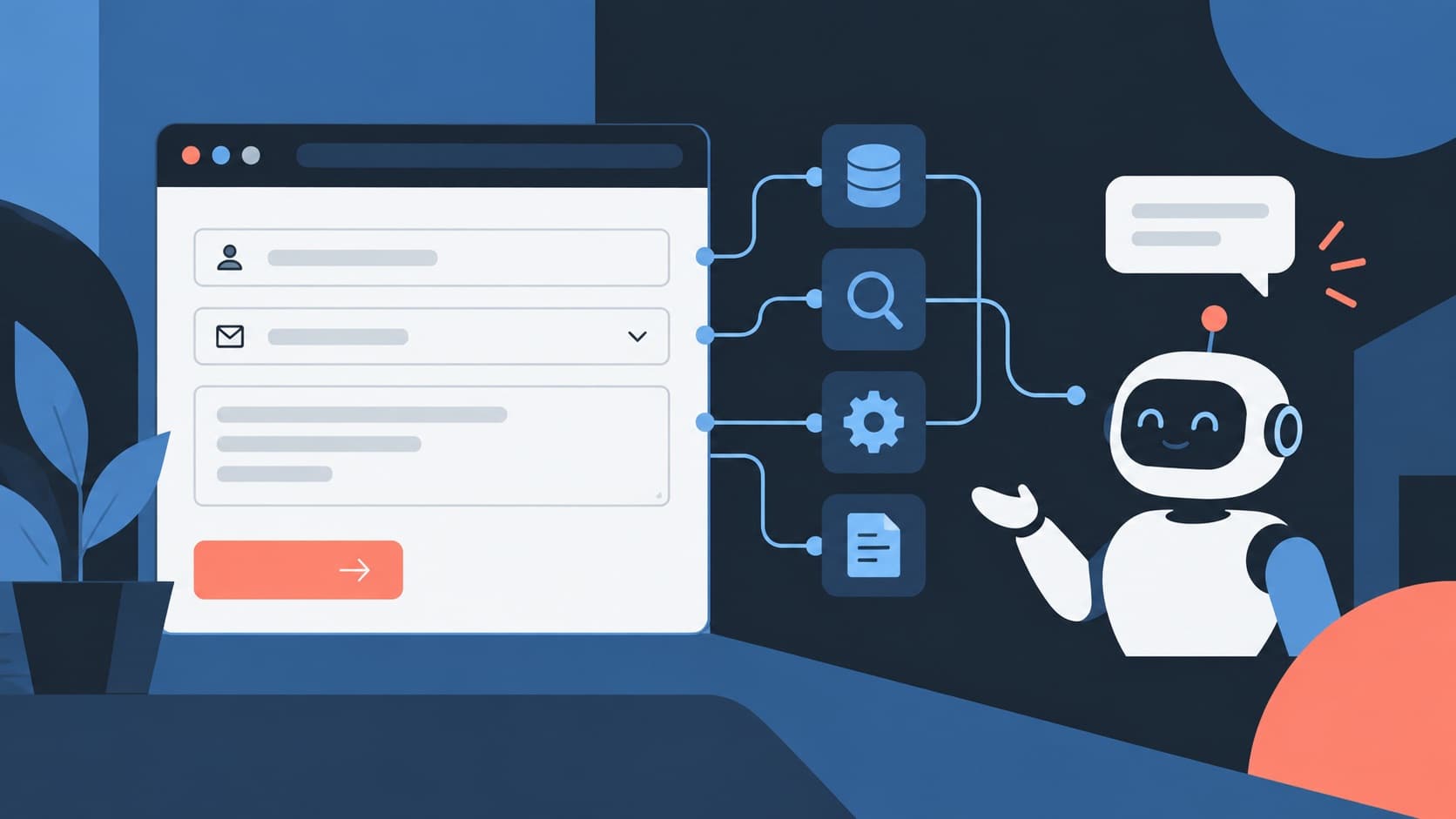
WebMCP (Web Model Context Protocol) is a planned W3C standard that Google and Microsoft contribute to. It lets websites offer structured tools to AI agents—instead of parsing HTML, agents call declared functions. Sites behave like MCP servers in the browser.
WebMCP proposes two APIs: a declarative one (tools directly in HTML forms) and an imperative one (complex interactions via JavaScript). For booking systems, shops, or editorial tools, that opens new possibilities: AI can search products, book appointments, or fill forms without scraping the page. After the Early Preview (February 2026), WebMCP has been in a public origin trial since Chrome 149 (June 2026, through Chrome 156)—with an origin trial token you can already test it in production with real users. Note: the API moved from navigator.modelContext to document.modelContext; the old surface is deprecated as of Chrome 150.
Example: how a site might register a product-search tool with WebMCP:
// WebMCP: register a product search tool
// (API status: origin trial, Chrome 150+)

const modelContext =
  document.modelContext || navigator.modelContext;

if (modelContext) {
  modelContext.registerTool({
    name: 'searchProducts',
    description: 'Search products in the shop',
    inputSchema: {
      type: 'object',
      properties: {
        query: { type: 'string', description: 'Search term' }
      },
      required: ['query']
    },
    execute: async ({ query }) => {
      const results = await fetch(
        `/api/products?q=${encodeURIComponent(query)}`
      );
      return results.json();
    }
  });
}
Robots.txt and AI crawlers: block or allow?
robots.txt controls which crawlers may access which areas. Many operators block AI training bots such as GPTBot (OpenAI) or ClaudeBot (Anthropic) to stop content being used for model training.
If you want to appear in AI answers, crawlers used for inference (answer generation) should be allowed access—otherwise your site cannot be used as a source.
Recommendation: check whether you can differentiate training and inference. If you allow crawling: use llms.txt and structured data. If you block: expect to be largely absent from AI-generated answers.
Since August 2026 there is one more reason: OpenAI uses OAI-AdsBot to crawl every landing page before an ad is served in ChatGPT. Block that bot and you cannot advertise there. What that means in practice is covered in ChatGPT ads launch in Germany and Austria.
Semantic HTML and accessibility
Semantic HTML—article, section, nav, sensible heading hierarchy, and aria-label—makes your page easier for every system to read. Screen readers and AI parsers benefit equally, and so does load time, because a clean structure usually means less code, as we describe in our post on lightweight websites. Your site also moves toward accessible websites.
- Headings: one clear H1 per page, logical H2–H6 hierarchy
- Alt text: descriptive alt text for every image
- Table of contents: fast navigation for users and AI
Content quality and clear statements
AI systems favour content that answers a question clearly and completely. Instead of pure marketing copy, expert content with real value pays off. A good start: a glossary—like the IVIS MEDIA glossary—or practical posts in News.
IVIS MEDIA supports you from content strategy through implementation. Start with a free AI readiness check to see whether your site is ready for the AI era.
Conclusion: make your website AI-ready
An AI-ready website combines bot accessibility (semantic HTML, Schema.org), llms.txt for a structured content map, forward-looking standards such as WebMCP, and clear, trustworthy copy. A deliberate approach to robots.txt and AI crawlers completes the strategy. Use our free AI readiness check to see how far along you are.
These measures also strengthen classic search engine optimisation and the user experience—a win-win. Our team can help you implement them.