WebMCP in 2026: structured tools instead of guesswork
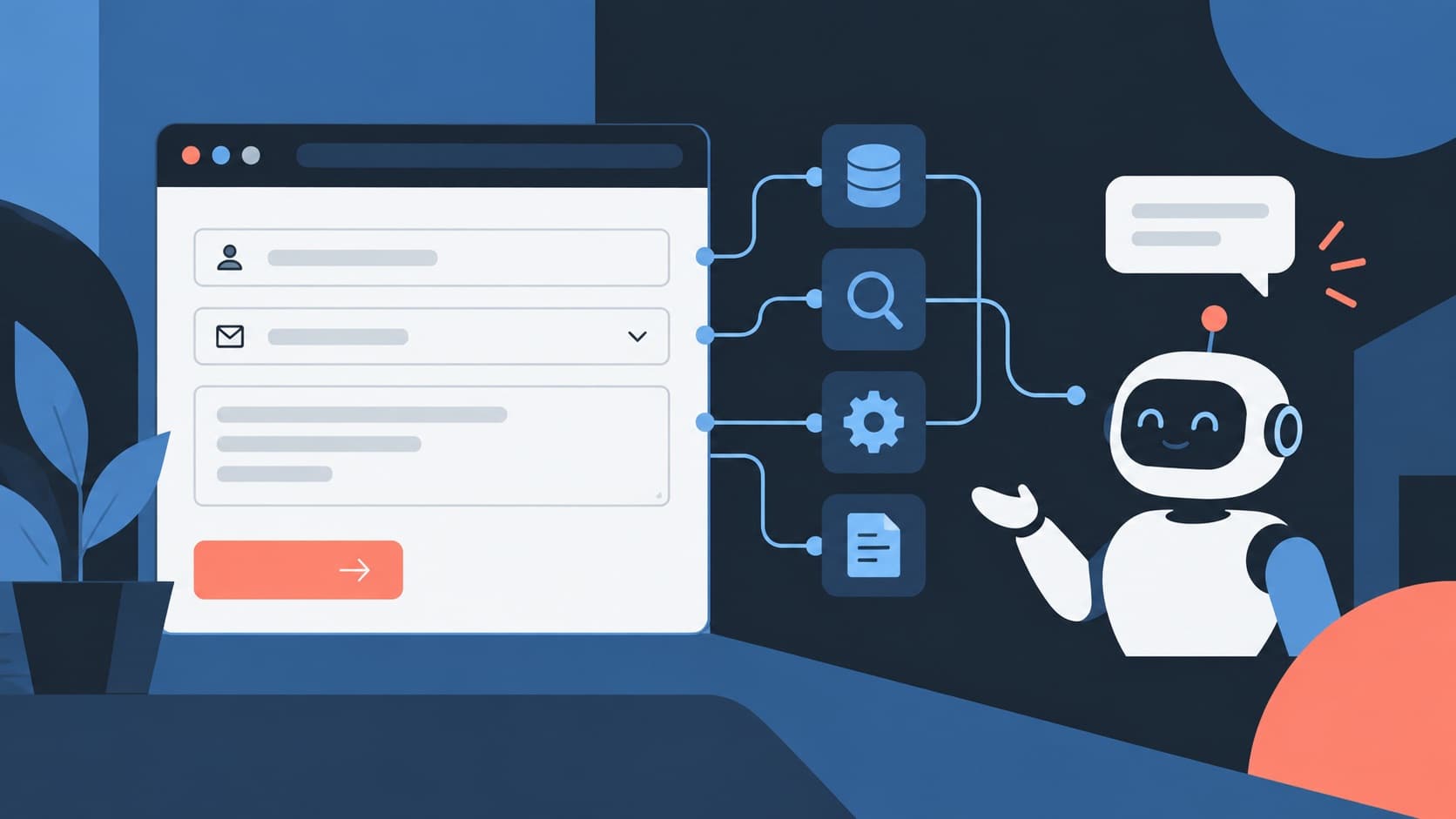
AI agents can operate websites through screenshots, the DOM, and the accessibility tree. That works, but dynamic interfaces still require interpretation: which field belongs to which product, when is a step complete, and which action triggers a payment? WebMCP proposes a browser interface through which a page registers structured tools.
The current Chrome documentation identifies discovery, JSON Schemas, and page state as core concepts. Rather than guessing how to use a button, an agent should call a tool with clear inputs and expected results. Execution remains visible in the website so users can understand what happened.
The important context is that WebMCP is not a finished cross-browser standard. Chrome presents the experiment as an origin trial, while W3C work still discusses agent identity, permissions, and interoperability. For product decisions, this is a signal to prototype, not to create a dependency.
Declarative and imperative tools
Declarative for structured forms
- A natural fit for interactions already modelled as forms.
- Labels, field types, and validation remain the basis for people, assistive technology, and agents.
Imperative for complex interactions
- Useful for dynamic product filters, appointment logic, or diagnostics requiring JavaScript.
- A tool description must never replace server-side business validation.
Chrome lists support, travel booking, and e-commerce among the potential use cases. A better website question is not ‘Which AI feature can we offer?’ but ‘Where does a real process fail today because of ambiguity or unnecessary steps?’. Only there can a tool produce a measurable benefit.
A tool should stay small, unambiguous, and able to report its result. searchProducts is easier to define than ‘buy something’. An appointment flow can search availability first while the final booking still requires visible confirmation.
Before a pilot: make the website legible to people and agents
The Web.dev guidance on agent-friendly websites does not start with a new API. It recommends semantic buttons and links, associated labels, stable layouts, and no transparent overlays on interactive elements. These practices also support accessibility, quality assurance, and conversion.
For IVIS MEDIA projects, that means real label elements, visible states and errors, comprehensible dialogs, and important actions that do not depend on hover or visual effects alone. Clear headings, Schema.org, and a maintained content structure also help search and AI systems interpret a page.
This foundation is not a substitute for security review. It does reduce the chance that an agent makes the wrong inference from a screenshot or a generic div.
A low-risk pilot in five steps
- Choose a flow: Pick a frequent, bounded problem such as search or support preparation.
- Describe the contract: Document name, purpose, inputs, outputs, failures, and side effects clearly.
- Reuse server rules: Run authorisation and validation exactly as in the normal web flow.
- Keep people involved: Show results visibly and require confirmation for sensitive steps.
- Measure and retain a fallback: Track success, errors, and abandonment; the standard flow must continue to work without support.
Conclusion and sources
WebMCP may help websites make recurring tasks less ambiguous for agents. Today, however, it is an experiment. The best next step is therefore an accessible, semantic, and secure website plus a small pilot with clear success criteria. For product teams, shops, and portals, web development can become a controlled learning field for agentic use.
Primary and technical sources: Chrome documentation, full URL: https://developer.chrome.com/docs/ai/webmcp ; Chrome Early Preview Program announcement: https://developer.chrome.com/blog/webmcp-epp ; Google Web.dev on agent-friendly UX: https://web.dev/articles/ai-agent-site-ux ; W3C WebML Community Group meeting minutes on experiments and open requirements: https://www.w3.org/2026/02/19-webmachinelearning-minutes.html